Shayan Fallahi, May 2nd 2022
On February 24th 2022, the Russian military crashed into Ukraine from five directions. In what was the most audacious political gamble of the 21st century, Vladimir Putin invaded Ukraine and threw Eastern Europe once more into the turbulence of war. Much has been said about Russia’s initial invasion of Ukraine; in the West, most coverage has been focused on criticising Russia’s failure to defeat Ukraine in the war’s opening stages and being forced to withdraw from the north of the country. The West portrays this as a foolish Russian attempt to defeat a Ukrainian military that it far underestimated. The Russians contend that this opening operation was somehow an attempt to weaken Ukraine so Russia could successfully focus its efforts on the Donbas region. Both claims are incorrect and essentially propagate misinformation. This article will explain as neutrally as possible the reality of Russia’s military intentions on February 24th and why they failed.
The Russian invasion of Ukraine on February 24th came as a surprise to many. This claim may seem bizarre, considering Russia had amassed around two hundred thousand men and all essential infrastructure and equipment necessary to launch an invasion, along with intelligence claims that an attack was imminent. Nevertheless, the Russian military build-up seemed insufficient to overwhelm the Ukrainian military. By February, the Ukrainian army was also some two hundred thousand strong, and standard military logic suggested that a three-to-one advantage in numbers was needed for a successful offensive. Moreover, wars in the 21st century seemed to be risky gambles that rarely paid off. US interventions in the Middle East had cost trillions and failed to achieve their political objectives. Finally, there seemed to be no imminent reason explaining why Russia should invade; Ukraine was not on the verge of joining NATO, nor was it on the verge of gaining any significant advantage which would warrant a response as substantial as an invasion. Russia did not seem to have sufficient force to win, nor did they seem to have a compelling reason to do so, and strenuously denied they had any intentions to invade up to the very last second.
Why?
This article is not intended to explain the political reasons why Russia invaded Ukraine; it will, however, lay out its military logic.
Indeed, when Russia invaded, it did so more audaciously and comprehensively than any imagined. Rather than invading the Donbas region, as seemed to be the most likely situation, they invaded the entire country from five directions. Russia denied its intentions up to the last second to maximise surprise, ensuring minimal Ukrainian forces were placed outside of the Donbas to enable Russian forces to quickly seize their intended targets, Ukraine’s political centres. Russia’s military thinking focused on ignoring the Ukrainian army altogether and instead aimed to rapidly disable Ukraine’s government. Once this was completed, it was believed the Ukrainian military would be unable to organise an effective resistance, allowing Russia to seize the entirety of Ukraine or change its government at a minimal cost. To disable the Ukraine government, Russia aimed to capture Kyiv itself rapidly, simultaneously taking key political centres such as Kherson Kharkov and Sumy across the country’s east.
This plan may seem unrealistic and overly ambitious; however, such a situation would not be unprecedented, and there are reasons why it was feasible. Weak states with poor national unity and central authority can quickly disintegrate against small military forces despite military logic dictating that the former should maintain an advantage. The Islamic state’s assault on Iraq in 2014 is a key example of when a small force routed a large and well-equipped military formation. It would have been impossible for ISIS to seize Mosul, a large urban centre, from a coherent Iraqi defence in 2014. ISIS’s capture of Mosul was not due to its military power but because the Iraqi military was incompetent and quickly collapsed into a panic. Another example was the fall of the Kabul government in Afghanistan in August 2021. Kabul was a well-fortified city with a large and well-equipped military force available to defend it. The Taliban, a poorly organised militia that lacked an air force or heavy weaponry, sized the entire city without a fight. This was again because the Kabul government had poor morale, weak national unity, and was racked with panic due to the American withdrawal. Russia itself already had a similar experience in Ukraine in 2014 when it seized Crimea from Ukraine without military resistance.
By February 2022, Putin saw Ukraine as an illegitimate state with no central unity, administered by a corrupt, unpopular government under the influence of western powers. He predicted that, despite Kyiv’s significant military forces, a rapid and decisive Russian strike that sized key political centres could cause the government’s immediate collapse with minimal violence. Such a quick strike would appear to be no more than a “special military operation”, hence the use of the term by the Russian government to describe the invasion.
Military Catastrophe.
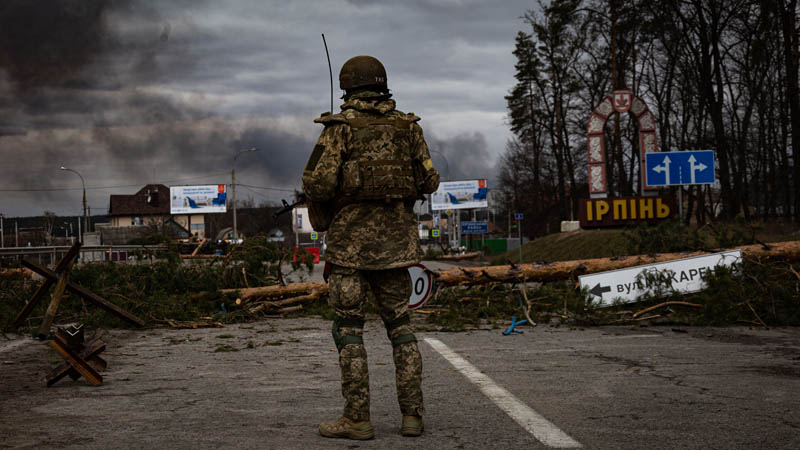
Russia’s attempt to dismantle the Ukrainian government came apart almost immediately. The military plan centred around an airborne capture of Hostomal airbase, an airstrip outside Kyiv. The Russian forces would then hastily build up airborne forces there, storm Kyiv, or disrupt its defences so the more extensive Russian formation advancing from Belarus could rapidly seize the city. However, the Russians failed to disable Ukraine’s air defence systems, preventing them from landing enough forces to advance on Kyiv. The Ukrainians then immediately organised a counterattack which scattered the weak initial landing party. The Russians, alarmed at the failure to size Kyiv, redirected most of their forces in the north of the country to take the city. The large formation advancing on Kyiv from Ukraine’s northern border with Belarus, intended initially to occupy Kyiv, now faced an organised Ukrainian defence bolstered by formidable natural and urban barriers. These forces attempted to press on regardless but failed to make it past the town of Irpin. Russia’s second force to assist in the capture of Kyiv advanced from the country’s north-western region of Sumy. These forces were in an even worse situation to assist as they had to bypass the city of Sumy and drive through nearly three hundred kilometres of hostile territory before reaching the city, at which time they were far too weak to launch an attack. The Russians quickly found themselves in an impossible military situation where they were increasingly outnumbered and outflanked. Moreover, due to inadequate logistical links to friendly territory and Ukrainian raids behind their lines, Russian supply lines quickly became horrendously inadequate, resulting in the loss of hundreds of vehicles due to a lack of fuel, ammunition or spare parts.
Though in the south of the country, Russia had successfully seized significant swaths of Ukraine, the city of Kherson, and surrounded Mariople, the strategic objective of dismantling Ukraine’s government had not been achieved. Consequently, Ukraine’s military could mount a coherent defence, preventing Russia from obtaining its political goals.
The Russian military situation in the north of Kyiv soon became critical as Russian forces were partially surrounded. The whole campaign had also become strategically irrelevant as it was now impossible to seize Kyiv. Accordingly, on March 29th, after just over a month of combat, Russia announced it would withdraw its troops from the entire country’s north and prepared itself for a much longer and more costly war of attrition to defeat the Ukrainian military.

Hindsight
Russia’s initial invasion of Ukraine in February of 2022 failed for two primary reasons. The first was that the Russian military failed to seize vital urban centres such as Kyiv and Kharkiv quickly. The second was that Putin had assumed that Ukraine lacked a national unity or spirit that could hold it together in the face of an invasion. It is not the first time a decision-maker has disregarded an opposing state’s willingness and competence to defend itself to such an extent that it attacked with an inferior military force. Mussolini believed Greece would rapidly capitulate in the face of his insufficient forces in 1940, and Saddam Hussein also assumed that the newly formed Islamic Republic of Iran would collapse when facing a comprehensive invasion in 1979. Perhaps most infamously, Germany’s invasion of the Soviet Union in 1941 was based on the logic that the USSR would collapse soon after the German attack and that fighting over the entire country would not be necessary. In all these cases, the assumptions proved false, and a bloody conflict ensued. Often, decision-makers views of their own country’s greatness or hatred of an enemy misguide their military calculations, resulting in strategic catastrophes.
Russia, however, has not yet lost the war in Ukraine. It has now redrawn its plans and aims to defeat or degrade the Ukrainian military comprehensively enough to force Kyiv to compromise, enabling them to pull some form of political victory from the conflict. However, Russia does not want this new phase of the conflict, which will become a drawn-out and costly war. The outcome will dictate the political future of the Russian Federation.